Steel Coils Explained: Hot Rolled vs. Cold Rolled Steel Coil, Types, Uses, and Buying Guide
Choosing the wrong steel coil can lead to forming problems, wasted material, and delayed production. A lower purchase price may look attractive until poor surface quality or incorrect dimensions affect your finished products. Understanding coil types and specifications helps buyers make safer, more cost-effective sourcing decisions.
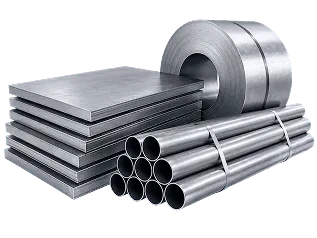
Steel coils are continuous lengths of rolled steel wound into compact rolls for storage, transport, and further processing. Hot rolled coils are generally used where strength and cost matter more than surface appearance. Cold rolled coils offer better surface finish and dimensional control. Galvanized, stainless, and coated coils serve applications requiring specific corrosion protection, appearance, or manufacturing performance.
What Is a Steel Coil and How Is It Manufactured?
A steel coil is a long, continuous strip of rolled metal wound into a circular roll. Instead of cutting every piece into individual flat sheets, mills supply the material in coil form. This makes transportation, storage, and continuous processing more efficient for many manufacturers.
Steel coils are widely used in industrial production because they can feed directly into stamping presses, roll-forming lines, tube mills, and cut-to-length equipment. The same parent coil may be processed into narrow strips, flat panels, or finished components.
The manufacturing route determines many of the material’s final properties. Hot rolling, cold reduction, annealing, coating, and finishing can all change the surface, dimensions, strength, and formability.
How Are Steel Coils Made?
The process generally begins with molten steel produced and refined to the required chemical composition. The metal is cast into slabs, which are reheated and passed through rolling mills.
A typical hot rolling process follows these stages:
- Steelmaking: The mill produces material with the required composition.
- Continuous casting: Molten metal is cast into steel slabs.
- Reheating: Slabs are heated to suitable rolling temperatures.
- Hot rolling: Rolling stands reduce the material to the target gauge.
- Cooling: The strip passes through controlled cooling equipment.
- Coiling: The finished strip is wound into coils for handling and transport.
The exact production route varies by mill and material specification.
Why Is Steel Supplied in Coil Form?
Coil form supports large-scale production because manufacturers can process long lengths of material with fewer interruptions.
For example, a roll-forming line producing roofing panels can continuously uncoil material, form the required profile, and cut finished pieces to length.
This arrangement can improve production efficiency and reduce manual handling compared with processing individual sheets.
However, coil handling requires suitable equipment. Buyers must consider the coil weight, inner diameter, outer diameter, and available lifting capacity.
What Are the Main Types of Steel Coils?
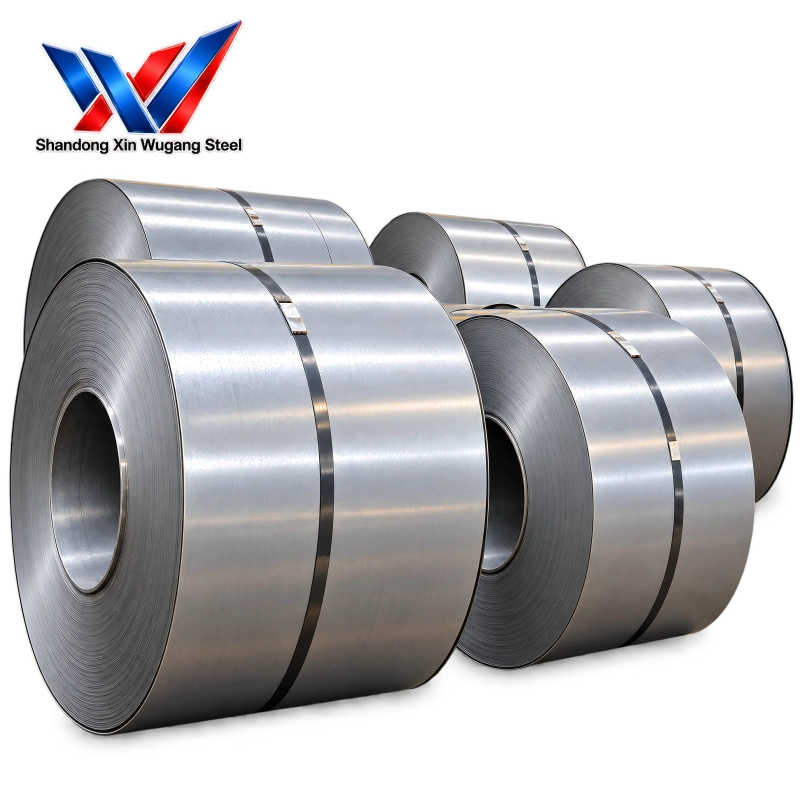
Different types of steel coils are designed for different applications. Some are selected mainly for structural strength, while others provide improved surface appearance, corrosion protection, magnetic performance, or forming capability.
Xin Wugang’s catalog includes carbon, stainless, galvanized, prepainted, alloy, tin-coated, and electrical steel coil categories.
The correct product depends on how the buyer will process and use the material.
Main Steel Coil Categories
| Coil type | Key characteristics | Typical applications |
|---|---|---|
| Hot rolled | Cost-effective for many structural and forming uses | Structural fabrication, welded tubes, machinery |
| Cold rolled | Better surface finish and dimensional control | Cabinets, appliance parts, precision formed components |
| Galvanized (GI) | Zinc-coated surface | Roofing, ventilation, construction components |
| Galvalume (GL) | Aluminum-zinc alloy coating | Roofing and exterior cladding |
| Prepainted (PPGI/PPGL) | Factory-applied organic coating | Colored roofing and wall panels |
| Stainless | Grade-dependent corrosion resistance | Food processing and industrial equipment |
| Alloy | Selected strength or temperature performance | Specialized industrial equipment |
| Tinplate | Thin metallic coating for packaging applications | Cans and metal packaging |
| Silicon steel | Controlled electrical and magnetic properties | Motors, transformers, generators |
Carbon steel is widely used in structural and general manufacturing applications. It is available in hot rolled and cold rolled forms, with different grades selected according to strength, formability, and welding requirements.
For example, a manufacturer producing welded tubes may prefer a hot rolled feedstock, while a company making precision cabinets may require a cold rolled material.
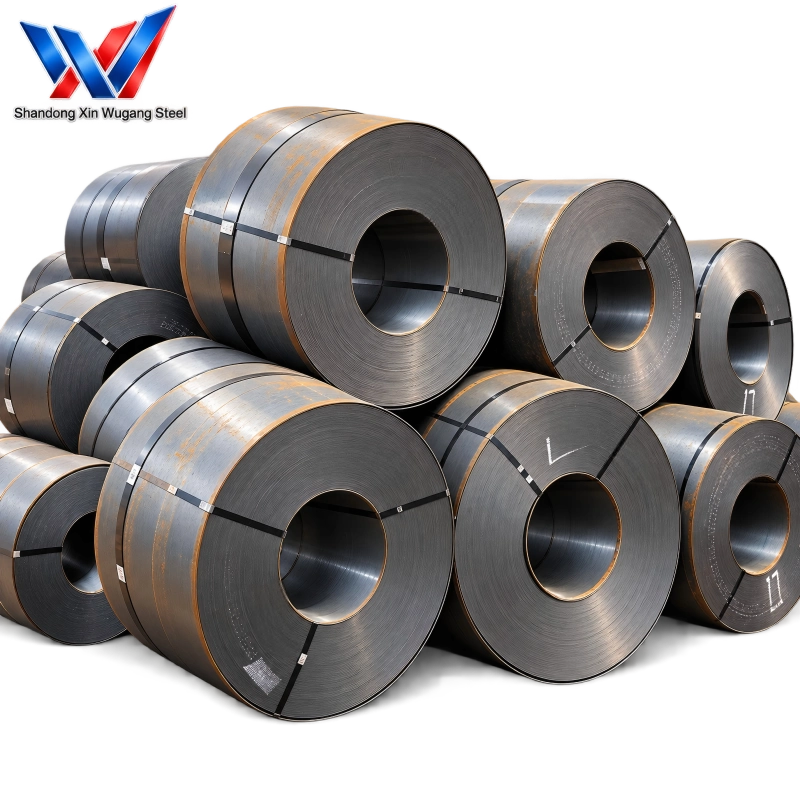
Stainless steel coils are used where appearance, hygiene, cleaning, or corrosion resistance matters.
Applications may include food processing equipment, chemical equipment, architectural components, and industrial enclosures.
The actual performance depends on the stainless grade, finish, and operating environment.
Coated Steel Coils
Galvanized steel and prepainted products are commonly used in building envelopes and fabricated components.
A galvanized coil has a protective zinc coating. PPGI and PPGL add an organic paint system over a suitable metallic-coated substrate.
Buyers should specify the coating mass, paint system, color, and intended environment rather than ordering only by product name.
Hot Rolled vs. Cold Rolled Steel Coil: What Is the Difference?
Hot rolled steel and cold rolled steel differ mainly in their processing routes and resulting properties.
Hot rolling takes place above the material’s recrystallization temperature, allowing the metal to deform more easily. Cold reduction takes place below that temperature, typically near room temperature, and is followed by further processing depending on the required final properties.
These routes affect surface finish, dimensional control, mechanical behavior, and cost.
A hot rolled steel coil is produced by reducing heated material through rolling stands and winding the finished strip into a roll.
The material commonly has an oxide scale surface unless it is pickled or otherwise treated.
It is often selected for structural components, machinery fabrication, welded pipes, and other uses where a mill-black surface is acceptable.
Cold Rolled Steel Coil
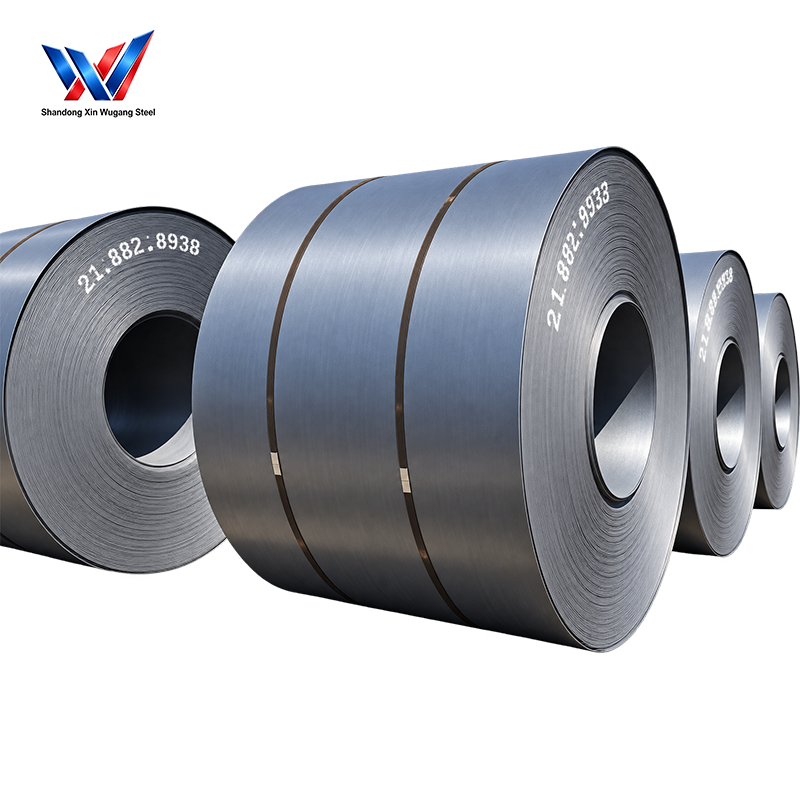
Cold rolled steel is commonly produced by reducing previously hot rolled and pickled strip at lower temperatures.
The process improves dimensional control and can produce smoother surfaces.
However, cold reduction also changes the material’s mechanical properties. Annealing may be required to restore the ductility and formability needed for stamping or deep drawing.
Hot Rolled vs. Cold Rolled Comparison
| Feature | Hot rolled | Cold rolled |
|---|---|---|
| Processing temperature | Above recrystallization temperature | Below recrystallization temperature |
| Surface | May contain oxide scale | Generally smoother and cleaner |
| Dimensional control | Depends on product standard and mill | Often tighter |
| Formability | Depends on grade and condition | Can be tailored through annealing |
| Cost | Often lower for comparable general-purpose material | Usually includes additional processing cost |
| Typical use | Structures, pipes, heavy fabrication | Appliances, cabinets, precision parts |
Which Should You Choose?
Choose hot rolled material when the application allows its surface condition and dimensional tolerances, and when it meets the required mechanical properties.
Choose cold rolled material when the finished product requires a smoother appearance, tighter dimensional tolerance, or a particular forming grade.
Neither option is universally stronger or better. The specified grade and delivery condition determine the relevant performance.
How Do Steel Coil Grades, Thickness, and Surface Finishes Affect Performance?
A coil’s grade tells the buyer which material specification and performance requirements apply. The same thickness and width can be available in different grades, but those products may behave differently during bending, stamping, welding, or roll forming.
For example, a general structural grade may be suitable for fabricated brackets, while a deep-drawing grade is intended for more demanding forming operations. Buyers should not assume that two grades are interchangeable simply because they have similar chemical compositions.
Common Grades and Product Standards
| Product category | Example grades | Relevant specifications |
|---|---|---|
| Hot-rolled carbon coil | Q235B, Q355B, A36, S355JR | Applicable GB, ASTM, or EN specifications |
| Cold-rolled carbon coil | SPCC, SPCD, SPCE, DC01, DC04 | JIS G 3141, EN 10130, as applicable |
| Galvanized coil | Commercial, drawing, and structural grades | ASTM A653/A653M, JIS G 3302 |
| Stainless coil | 304, 316, 430 | ASTM A240/A240M and relevant specifications |
| Electrical coil | CRGO, CRNO grades | Applicable electrical steel standards |
Grade designations and specifications must be matched carefully. For example, SPCC is associated with JIS G 3141, not JIS G 3131.
Why Do Surface Finish and Dimensional Tolerance Matter?
Surface condition affects downstream manufacturing. A cold-rolled strip with a clean, smooth finish may be appropriate for visible appliance panels. A mill-black product may be suitable for components that will undergo further fabrication or surface treatment.
Buyers should also specify width tolerance, thickness tolerance, flatness, edge condition, and surface quality. These details are particularly important for automated production lines where small variations can interrupt feeding or stamping.
Xin Wugang’s catalog lists hot-rolled black, pickled-and-oiled, cold-rolled bright, stainless 2B/BA, galvanized, prepainted, and tin-coated finishes. Availability depends on the product and specification.
Where Are Steel Coils Used in Manufacturing and Construction?
Steel coils support diverse applications because manufacturers can convert them into flat sheets, narrow strips, formed sections, welded tubes, and finished parts.
In construction, galvanized and prepainted products are commonly processed into roofing, wall cladding, flashing, ventilation components, and other building materials. In machinery manufacturing, hot rolled and cold rolled products can become brackets, housings, guards, and structural components.
Construction and infrastructure
Roofing, wall panels, formed sections, and ventilation products.
Automotive manufacturing
Selected stamped and formed vehicle components.
Household appliances
Cabinets, enclosures, and formed panels.
Pipe and tube manufacturing
Continuous strip feedstock for welded pipe production.
Application-Based Material Selection
| Industry sector | Common material choice | Main purchasing concern |
|---|---|---|
| Construction | GI, GL, PPGI, PPGL | Coating, forming, weather exposure |
| Automotive | Specified HR or CR grades | Formability, strength, surface quality |
| Appliance manufacturing | Cold-rolled or coated products | Appearance, dimensional accuracy |
| Machinery | HR, CR, stainless, alloy | Strength, welding, processing |
| Food processing | Selected stainless grades | Cleaning and hygiene requirements |
| Metal packaging | Tinplate and tin-free products | Temper, coating, forming |
| Electrical equipment | Silicon steel | Magnetic losses and electrical performance |
Medical equipment manufacturers may also use specified stainless or coated materials for housings and fabricated components. However, the correct material and finish depend on the product’s regulatory and cleaning requirements.
For overseas buyers, application-based selection helps avoid paying for properties that are not needed while ensuring the material meets the final product’s performance requirements.
How Are Steel Coils Slit, Cut, and Processed?
A master coil often requires additional processing before a manufacturer can use it. Common services include slitting, cut-to-length processing, pickling, oiling, leveling, and surface finishing.
Slitting divides a wide master coil into narrower strips. Cut-to-length processing uncoils, levels, and cuts material into flat sheets. Both operations can improve compatibility with the customer’s production equipment.
Common Coil Processing Services
| Service | Purpose | Information required |
|---|---|---|
| Slitting | Produce narrow strips | Finished width, tolerance, quantity |
| Cut-to-length | Produce flat sheets | Length, flatness, dimensions |
| Leveling | Reduce unwanted curvature | Flatness requirements |
| Pickling | Remove suitable surface oxides | Grade and finish requirements |
| Oiling | Provide temporary surface protection | Oil type and downstream processing |
| Recoiling | Prepare coils for handling | Inner diameter, outer diameter, weight |
| Surface finishing | Meet appearance or process needs | Finish specification |
Xin Wugang lists slitting, cutting, and surface treatment among its available processing services. Minimum strip width, dimensional limits, and final coil diameters should be confirmed before ordering.
Why Does Coil Diameter Matter?
A coil may have the correct grade and width but still be unsuitable for the customer’s uncoiler.
Before purchasing, confirm the required inner diameter, maximum outer diameter, maximum weight per roll, and feeding direction where relevant.
For automation equipment, these details can be as important as the metal specification itself. A mismatched coil may require extra handling or processing before production can begin.
What Quality Checks Ensure Steel Coil Reliability?
Reliable coil supply requires more than checking the visible surface. A buyer should verify the material specification, dimensions, mechanical properties, finish, and traceability before shipment.
The inspection plan should match the product. A hot-rolled structural material may need different checks from a deep-drawing cold-rolled product or a galvanized coil for roofing.
Recommended Quality Inspection Checklist
| Inspection item | What to verify |
|---|---|
| Material identification | Grade, standard, heat number |
| Chemical composition | Compliance with the agreed specification |
| Mechanical testing | Tensile strength, yield properties, elongation where required |
| Dimensions | Thickness, width, and tolerances |
| Surface condition | Scale, scratches, rust, coating defects |
| Flatness and shape | Camber, edge wave, center buckle where relevant |
| Coating | Coating mass, thickness, adhesion where specified |
| Coil condition | Edge damage, telescoping, loose winding |
| Documentation | Mill Test Certificate and inspection records |
| Packaging | Protection, marking, and securing |
Why Is Surface Inspection Important?
A material may meet its chemical and mechanical requirements but still create problems during processing.
For example, damaged edges can interfere with slitting, while surface defects may become visible after painting or stamping.
Cold rolled material intended for smooth, exposed components often requires more specific surface acceptance criteria than material intended for hidden structural parts.
What Documents Should Importers Request?
Xin Wugang states that mill test certificates are supplied for each batch and that third-party inspections, including SGS or BV, can be arranged upon request.Buyers should define the exact document scope in the purchase contract. Certificates should match the supplied material and relevant heat or batch identification.
For coated products, the inspection plan may also include coating mass, paint properties, and agreed surface acceptance criteria.
How Should Importers Choose a Steel Coil Supplier?
Choosing a steel coil supplier is a commercial and technical decision. Price matters, but so do material consistency, processing capability, inspection, communication, and delivery arrangements.
For importers and distributors, the ability to source several grades and finishes through one supply partner can simplify purchasing. For manufacturers, compatibility with existing production equipment is often the priority.
Steel Coil Purchasing Checklist
| Purchasing factor | Questions to ask |
|---|---|
| Product range | Can the supplier provide the required coil type? |
| Material standard | Is the exact grade available? |
| Dimensions | Are the required gauge and width supported? |
| Processing | Can the material be slit or cut? |
| Coil parameters | Are ID, OD, and weight suitable? |
| Quality | Are material certificates available? |
| Inspection | Can independent checks be arranged? |
| Logistics | How will the coils be packed and shipped? |
| Lead time | Is the material in stock or mill-produced? |
| After-sales | How are discrepancies handled? |
Why Should You Compare Total Procurement Costs?
A lower price per ton does not always mean a lower total cost.
Buyers should account for processing charges, inspection, packaging, inland transportation, ocean freight, insurance, import duties, and local handling.
For example, buying a wide master coil may appear cheaper than purchasing slit strips. But if the customer lacks suitable slitting equipment, the additional processing cost can change the comparison.
What About Export Packaging?
Steel coils are heavy and must be secured correctly during transport.
Packaging may include suitable wrapping, edge protection, steel strapping, identification labels, and moisture protection, depending on the product and agreed shipping method.
Container loading must also respect weight distribution, securing requirements, and the limits of the container and handling equipment.
A good export plan protects the material while making unloading and identification easier at the destination.
Why Source Steel Coils from Shandong Xin Wugang Steel?
Shandong Xin Wugang Steel Co., Ltd. is a comprehensive steel and non-ferrous metal supplier based in Liaocheng, Shandong, China. We support overseas importers, wholesalers, distributors, construction contractors, and industrial manufacturers with multi-category metal sourcing.
Our focus is not limited to one coil product. We coordinate material selection, mill sourcing, custom processing, quality documentation, export packaging, and international delivery.
Our Steel Coil Supply Range
Our product portfolio includes:
- Hot-rolled and cold-rolled carbon coils.
- Galvanized and Galvalume coils.
- Prepainted galvanized and Galvalume coils.
- Stainless coils and precision strips.
- Alloy coils for specialized applications.
- Tinplate and tin-free products.
- Grain-oriented and non-grain-oriented electrical coils.
We also supply steel plates, pipes, bars, structural sections, wire and mesh, abrasives, and non-ferrous metals.
Why Work with Xin Wugang?
Direct mill sourcing: Our published supply network includes Baowu Steel Group, Baosteel, Shougang Group, and Baotou Steel.
Custom processing: We coordinate slitting, cutting, and selected surface treatments according to confirmed specifications.
Quality documentation: We support material traceability through mill documentation and agreed inspection arrangements.
Integrated procurement: Customers purchasing several metal categories can coordinate their requirements through one supplier.
Export services: We assist with packaging, shipment coordination, and required trade documentation.
How Much Steel Can You Order?
According to our published catalog, regular carbon steel coil orders generally start at 5 metric tons. Stainless, galvanized, and prepainted coils typically have minimum quantities of 3–5 metric tons, while special materials may require larger lots. Small trial orders are subject to stock availability.
Final quantities, availability, and lead times must be confirmed for each specification.
Request a Steel Coil Quotation
Whether you need hot rolled steel for structural fabrication, cold rolled material for precision components, or coated coils for building products, our team can review your requirements.
Please send us:
- Product type and material grade.
- Required standard.
- Thickness and width.
- Coil inner diameter and target weight.
- Surface finish or coating requirements.
- Slitting or cut-to-length requirements.
- Total order quantity.
- Destination country and port.
Contact Shandong Xin Wugang Steel Co., Ltd. for customized steel coil sourcing and bulk export quotations.
Email: Sara@x-wusteel.com
Phone / WhatsApp: +86 19863513853
Website: Xin Wugang Steel
Product Catalog: Steel Coil & Strip
FAQ
What is the difference between hot rolled and cold rolled steel coils?
Hot rolled coils are produced at elevated temperatures and commonly used for structural and general fabrication applications. Cold rolled coils undergo further reduction at lower temperatures, often providing smoother surfaces and tighter dimensional control. The correct choice depends on the required grade, finish, tolerances, and forming performance.
What are the most common steel coil types?
Common types include hot rolled, cold rolled, galvanized, Galvalume, prepainted, stainless, alloy, tinplate, and electrical steel coils. Each category serves different manufacturing and industrial requirements.
Can steel coils be slit into narrower strips?
Yes. Wide master coils can be slit into narrower strips where the material and processing equipment permit. Buyers should specify the finished width, tolerance, coil diameter, edge condition, and required quantity
How is steel coil weight calculated?
For ordinary carbon steel, an approximate calculation is length in meters × width in meters × thickness in millimeters × 7.85. The result is in kilograms. Actual weight should be verified against the supplier's measurement records.
Which steel coil is best for roofing and wall panels?
Galvanized, Galvalume, PPGI, and PPGL coils are commonly used for roofing and cladding. The correct choice depends on the coating system, environmental exposure, forming process, appearance requirements, and project specification.
What documents should I request when importing steel coils from China?
Buyers commonly request a Mill Test Certificate, commercial invoice, packing list, bill of lading, and certificate of origin where required. Third-party inspection records may also be needed for specific contracts.