Chinese
Production Process
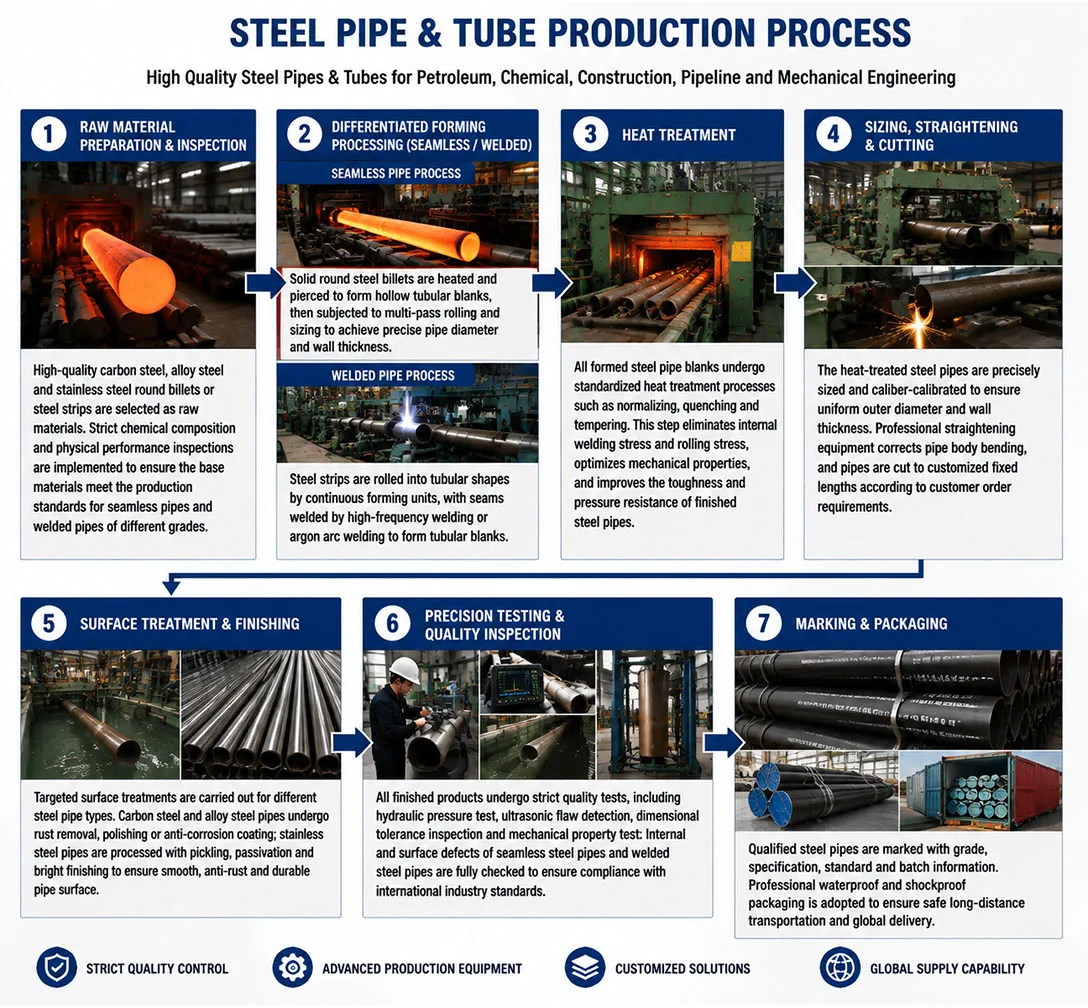
From Raw Material To Finished Product — Quality Controlled At Every Step.
Steel Bar/Rod + Structural Section/Profile + Wire & Mesh
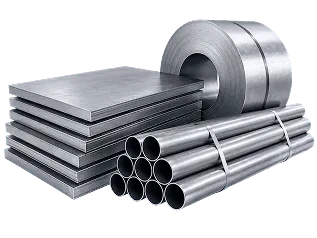
Plates, Coils And Strips For Construction, Fabrication And Industrial Manufacturing
Steel Bar & Rebar
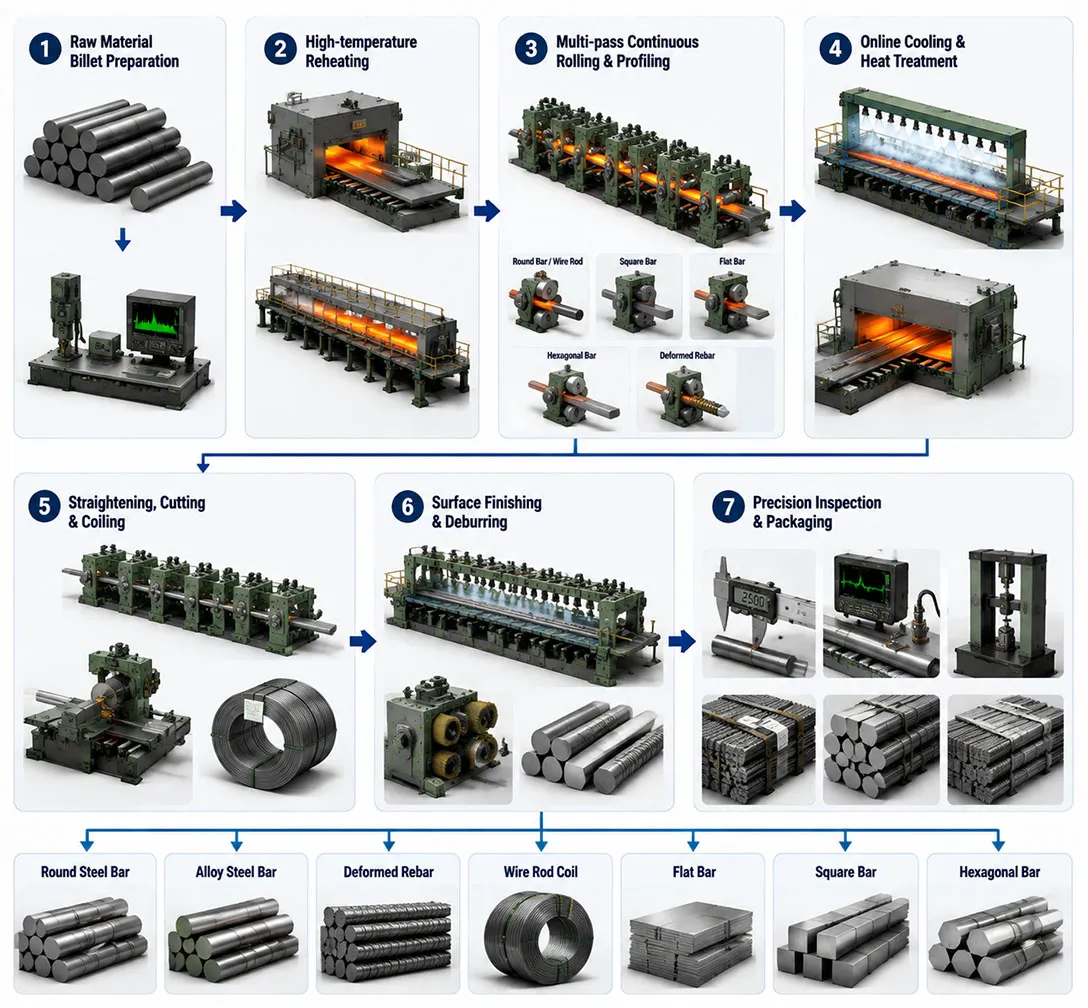
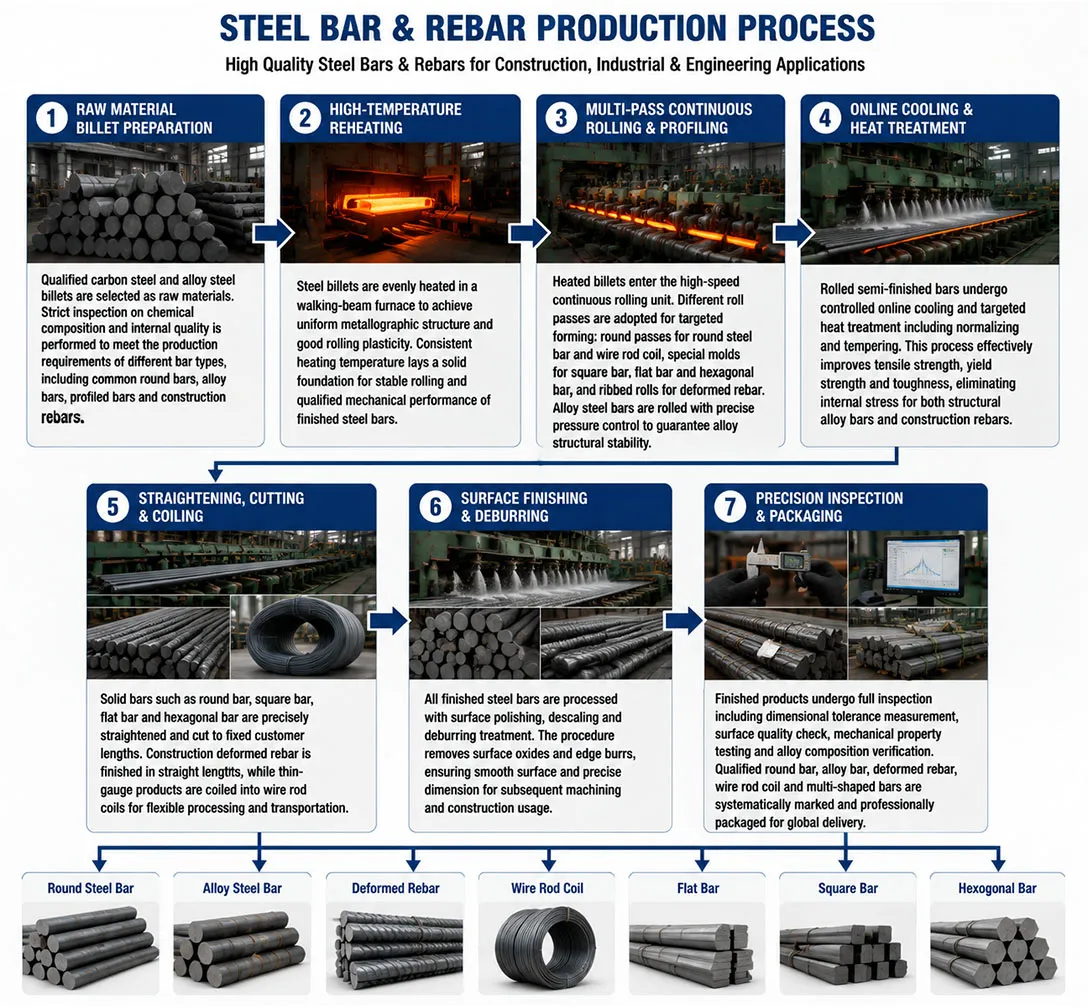
This production workflow covers a full range of bar products, including round steel bar, alloy steel bar, deformed rebar, wire rod coil, and multi-shaped structural bars such as flat bar, square bar, and hexagonal bar. Through precise heating, continuous rolling, online shaping, cooling and finishing treatment, these steel bars deliver stable strength, excellent ductility and accurate dimensional tolerance. They are widely used in building reinforcement, mechanical manufacturing, structural engineering and industrial fabrication for global construction projects.
1. Raw Material Billet Preparation
Qualified carbon steel and alloy steel billets are selected as raw materials. Strict inspection on chemical composition and internal quality is performed to meet the production requirements of different bar types, including common round bars, alloy bars, profiled bars and construction rebars.
2. High-temperature Reheating
Steel billets are evenly heated in a walking-beam furnace to achieve uniform metallographic structure and good rolling plasticity. Consistent heating temperature lays a solid foundation for stable rolling and qualified mechanical performance of finished steel bars.
3. Multi-pass Continuous Rolling & Profiling
Heated billets enter the high-speed continuous rolling unit. Different roll passes are adopted for targeted forming: round passes for round steel bar and wire rod coil, special molds for square bar, flat bar and hexagonal bar, and ribbed rolls for deformed rebar. Alloy steel bars are rolled with precise pressure control to guarantee alloy structural stability.
4. Online Cooling & Heat Treatment
Rolled semi-finished bars undergo controlled online cooling and targeted heat treatment including normalizing and tempering. This process effectively improves tensile strength, yield strength and toughness, eliminating internal stress for both structural alloy bars and construction rebars.
5. Straightening, Cutting & Coiling
Solid bars such as round bar, square bar, flat bar and hexagonal bar are precisely straightened and cut to fixed customer lengths. Construction deformed rebar is finished in straight lengths, while thin-gauge products are coiled into wire rod coils for flexible processing and transportation.
6. Surface Finishing & Deburring
All finished steel bars are processed with surface polishing, descaling and deburring treatment. The procedure removes surface oxides and edge burrs, ensuring smooth surface and precise dimension for subsequent machining and construction usage.
7. Precision Inspection & Packaging
Finished products undergo full inspection including dimensional tolerance measurement, surface quality check, mechanical property testing and alloy composition verification. Qualified round bar, alloy bar, deformed rebar, wire rod coil and multi-shaped bars are systematically marked and professionally packaged for global delivery.
Steel Profiles
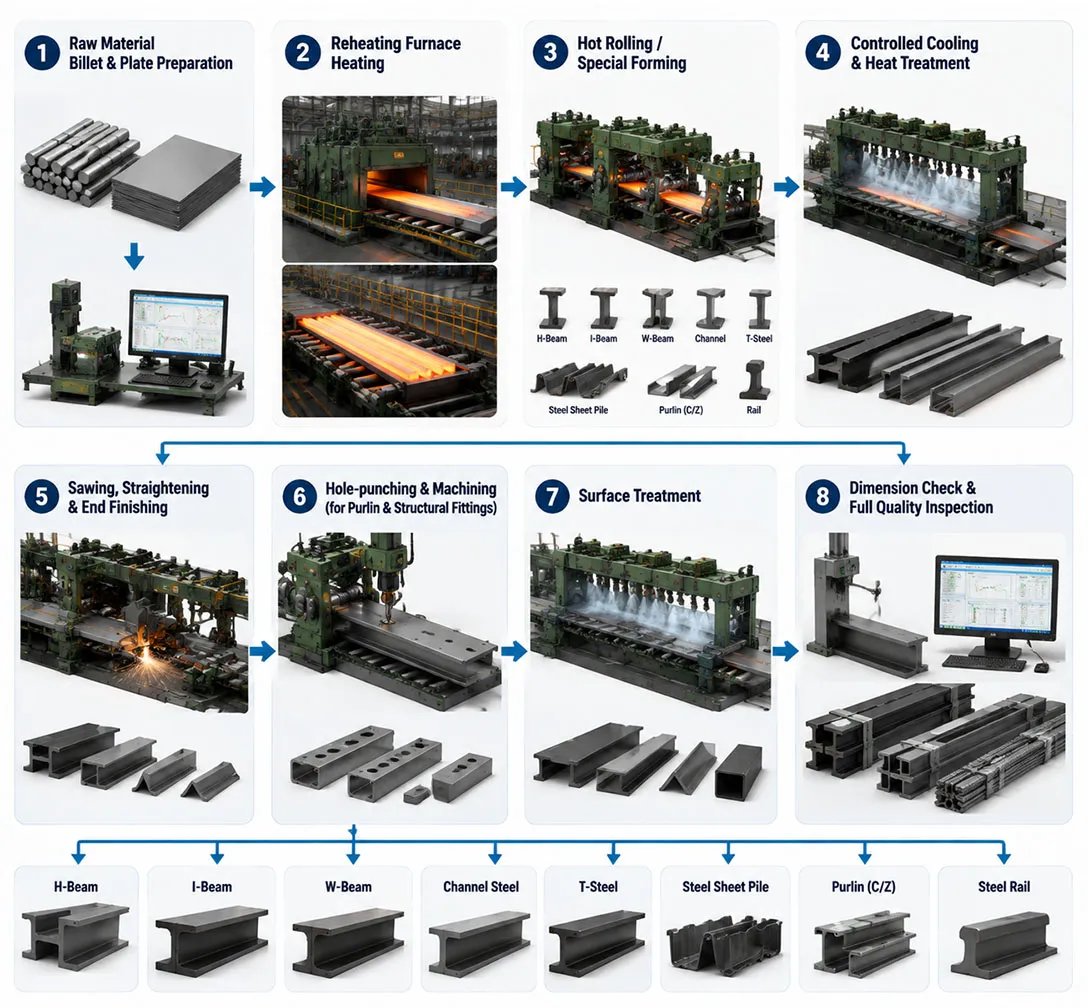
This production workflow covers H‑beam, I‑beam, W‑beam, channel steel, T‑steel, steel sheet pile, purlin and steel rail. These structural profiles are manufactured via hot rolling, cold forming and specialized shaping processes. With stable mechanical performance and accurate section dimension, they serve as core structural components widely applied in steel‑structure buildings, bridge engineering, foundation support, railway transportation and heavy‑duty infrastructure projects worldwide.
1. Raw Material Billet & Plate Preparation
Qualified carbon and low‑alloy steel blooms, beam blanks and heavy steel plates are selected as raw materials. Chemical composition and internal quality are strictly checked to satisfy grade requirements for H‑beam, channel, sheet pile, steel rail and other profile products.
2. Reheating Furnace Heating
Raw blanks or steel plates are evenly reheated to target rolling temperature inside the reheating furnace. Uniform heating optimizes metal plasticity, avoids rolling defects, and guarantees consistent mechanical properties for subsequent forming.
3. Hot Rolling / Special Forming
Different forming routes apply for different profile categories. H‑beam, I‑beam, W‑beam, channel steel, T‑steel and steel rail adopt multi‑pass universal hot rolling mill to form standard cross‑section profiles. Steel sheet pile is produced by special hot rolling passes for interlocking latch structure. Purlin mostly adopts cold roll‑forming process from steel coil to obtain lightweight C‑shape or Z‑shape cross‑sections.
4. Controlled Cooling & Heat Treatment
Hot‑rolled profiles go through controlled cooling procedure. High‑load products such as steel rail and steel sheet pile will receive additional normalizing or tempering treatment. This step releases rolling residual stress and improves strength, hardness and impact resistance for structural service.
5. Sawing, Straightening & End Finishing
All profiles are sent to straightening machines to correct bending and twisting deformation. Products are sawn to customer‑specified fixed lengths. End faces are cut and trimmed, removing burrs for H‑beam, channel, T‑steel, steel rail and sheet‑pile products.
6. Hole‑punching & Machining (for purlin & structural fittings)
For purlin and fabricated structural profiles, punching, drilling and cutting operations are performed according to drawing requirements, pre‑processing connection holes for site installation convenience.
7. Surface Treatment
Surfaces are cleaned to remove rolling scale. Profiles can be supplied in black hot‑rolled condition, or customized with shot blasting, priming paint for anti‑corrosion as per client demands.
8. Dimension Check & Full Quality Inspection
Inspection includes cross‑section dimension testing, straightness measurement, surface defect examination and mechanical property verification. Critical items like interlock tolerance of steel sheet pile and hardness index of steel rail are specially tested. Qualified H‑beam, I‑beam, W‑beam, channel steel, T‑steel, steel sheet pile, purlin and steel rail are marked, bundled and packaged for global shipment.
Wire, Rope, Mesh & Barbed Wire
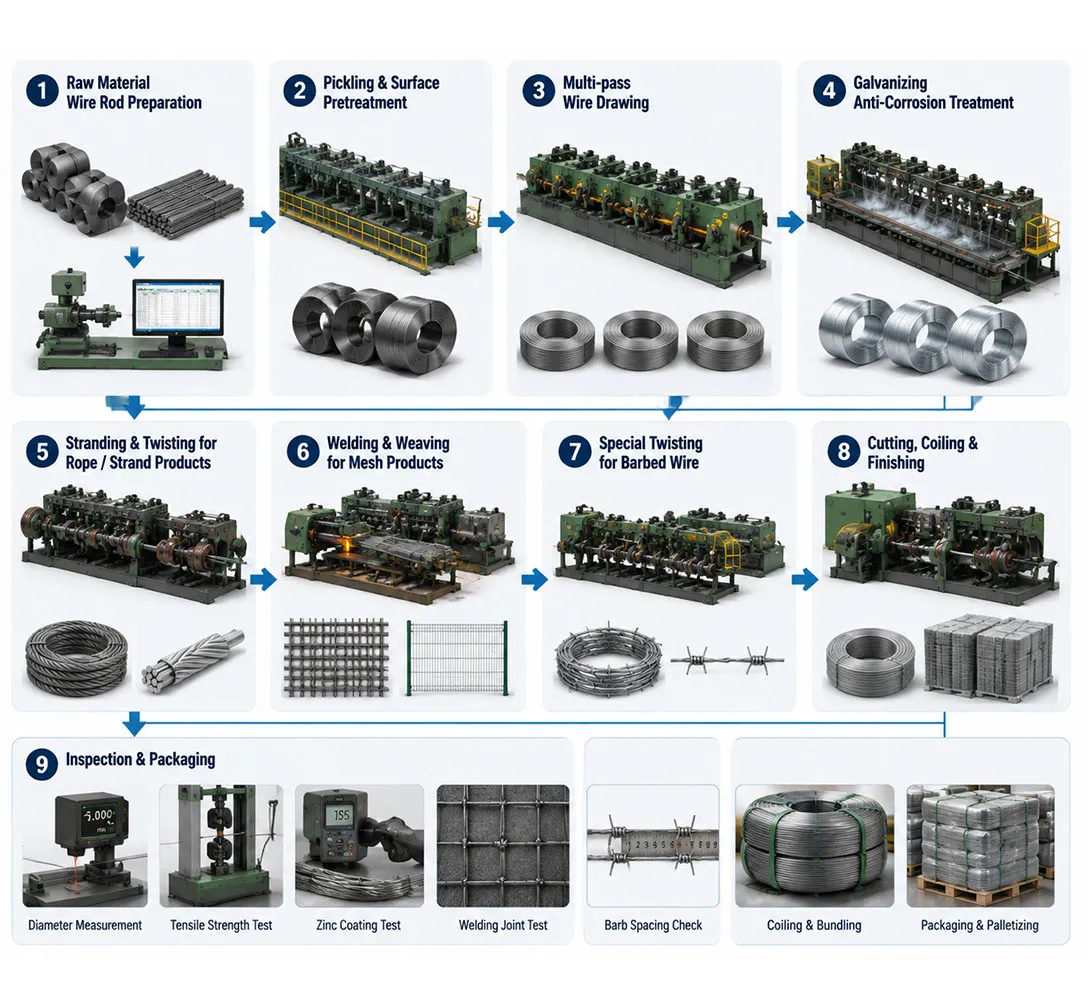
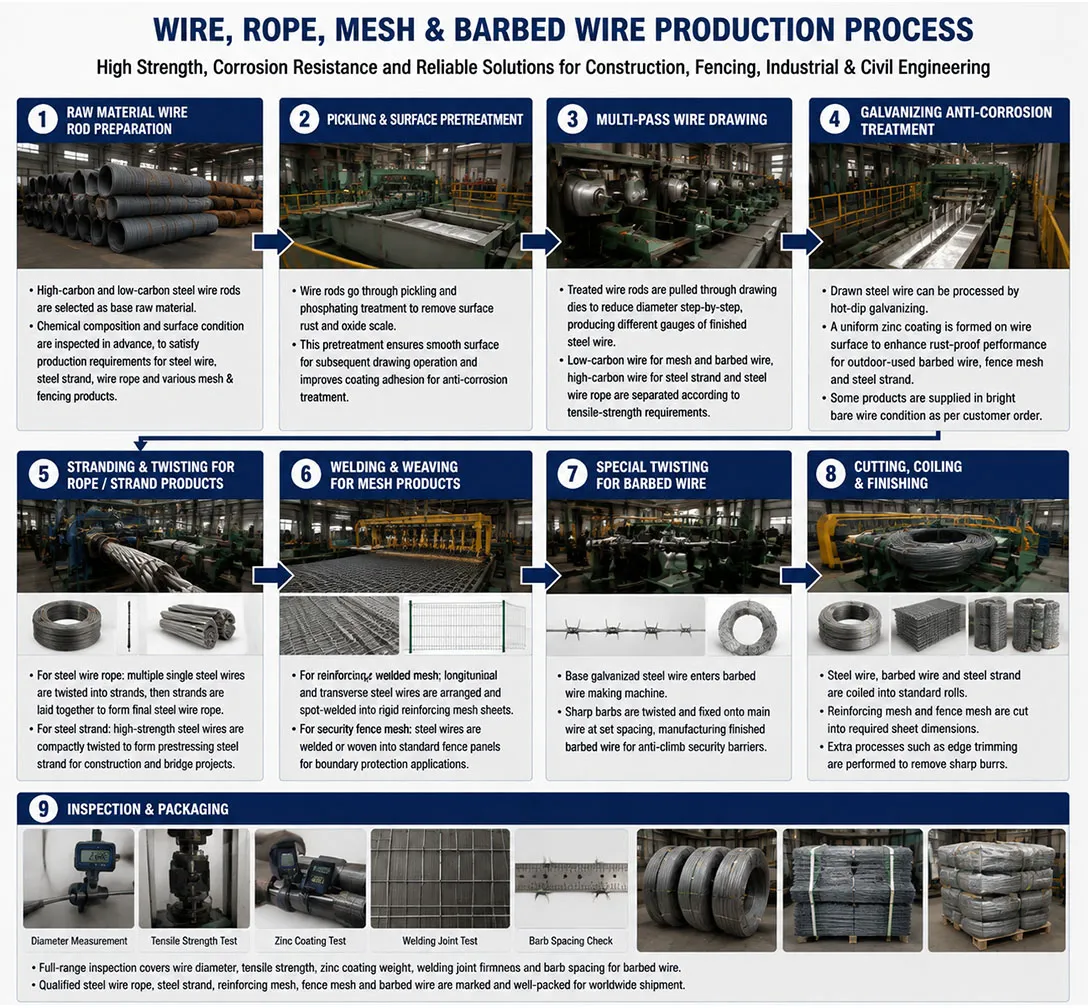
This production workflow covers steel wire, steel wire rope, steel strand, reinforcing welded mesh, security fence mesh and barbed wire. Starting from high‑quality steel wire rod, products go through wire drawing, galvanizing, stranding, welding and special twisting processes. These finished items feature high tensile strength, good corrosion resistance and uniform structure, widely used for building reinforcement, perimeter security, transportation fencing, mine support and civil engineering projects across global markets.
1. Raw Material Wire Rod Preparation
High‑carbon and low‑carbon steel wire rods are selected as base raw material. Chemical composition and surface condition are inspected in advance, to satisfy production requirements for steel wire, steel strand, wire rope and various mesh & fencing products.
2. Pickling & Surface Pretreatment
Wire rods go through pickling and phosphating treatment to remove surface rust and oxide scale. This pretreatment ensures smooth surface for subsequent drawing operation and improves coating adhesion for anti‑corrosion treatment.
3. Multi‑pass Wire Drawing
Treated wire rods are pulled through drawing dies to reduce diameter step‑by‑step, producing different gauges of finished steel wire. Low‑carbon wire for mesh and barbed wire, high‑carbon wire for steel strand and steel wire rope are separated according to tensile‑strength requirements.
4. Galvanizing Anti‑Corrosion Treatment
Drawn steel wire can be processed by hot‑dip galvanizing. A uniform zinc coating is formed on wire surface to enhance rust‑proof performance for outdoor‑used barbed wire, fence mesh and steel strand. Some products are supplied in bright bare wire condition as per customer order.
5. Stranding & Twisting for Rope / Strand Products
For steel wire rope: multiple single steel wires are twisted into strands, then strands are laid together to form final steel wire rope.
For steel strand: high‑strength steel wires are compactly twisted to form prestressing steel strand for construction and bridge projects.
6. Welding & Weaving for Mesh Products
For reinforcing welded mesh: longitudinal and transverse steel wires are arranged and spot‑welded into rigid reinforcing mesh sheets.
For security fence mesh: steel wires are welded or woven into standard fence panels for boundary protection applications.
7. Special Twisting for Barbed Wire
Base galvanized steel wire enters barbed wire making machine. Sharp barbs are twisted and fixed onto main wire at set spacing, manufacturing finished barbed wire for anti‑climb security barriers.
8. Cutting, Coiling & Finishing
Steel wire, barbed wire and steel strand are coiled into standard rolls. Reinforcing mesh and fence mesh are cut into required sheet dimensions. Extra processes such as edge trimming are performed to remove sharp burrs.
9. Inspection & Packaging
Full‑range inspection covers wire diameter, tensile strength, zinc coating weight, welding joint firmness and barb spacing for barbed wire. Qualified steel wire rope, steel strand, reinforcing mesh, fence mesh and barbed wire are marked and well‑packed for worldwide shipment.